24-hour service hotline
0086 18733132385
Send us an email
xrguo@xinhaimining.net

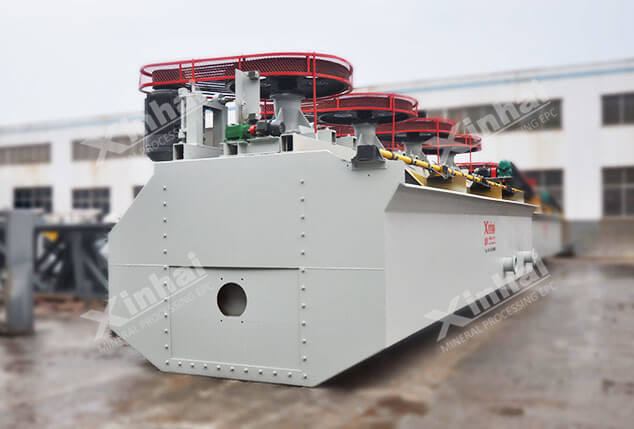
Lepidolite ores are mostly of the fine-grained type, and lepidolite is mainly symbiotically embedded with gangue minerals such as quartz and feldspar. Since lepidolite is a silicate mineral, the ore mainly takes on a flake or scale-like structure after monomer dissociation. Coarse-grained lepidolite is generally enriched by hand selection, air separation or friction separation, and fine-grained lepidolite is enriched by flotation. The recycling method is more effective.
Flotation is the main beneficiation method for lepidolite. The selection of suitable flotation reagents has become one of the important factors in improving the development and utilization of lepidolite resources.
In-depth research on the mechanism of action of lepidolite collector. Exploring the adsorption mode and combination mechanism of lepidolite by collectors, improving the flotation environment, improving the selectivity of amine collectors and the synergy between combined collectors will help improve the use of conventional collectors in lepidolite concentrators. Applications.
Graphite is a black lustrous mineral formed in a range of metamorphic and hydrothermal environments. Natural graphite can be divided into crystalline graphite (flake graphite) and cryptocrystalline graphite (earth graphite) according to the crystal form.
The grinding and grading stage of lithium ore is to ensure that lithium minerals and gangue minerals are fully free. Therefore, the extraction of lithium ore is inseparable from the grinding of ore, and the commonly used equipment for grinding lithium ore is a ball mill. The first-level closed-circuit grinding and classification process can be used. The first-level grinding equipment can use wet grid ball mills, rod mills, etc., and the wet overflow ball mill can be used for secondary grinding.
© 2021 Yantai KZ Mining Processing Technology & Equipment Inc.