24-hour service hotline
0086 18733132385
Send us an email
xrguo@xinhaimining.net

Graphite ore constitutes a significant non-metallic mineral resource, frequently occurring alongside quartz, illite, kaolinite, and kyanite, as well as sericite and minor quantities of pyrite, limonite, tourmaline, and calcite. It requires mineral processing for purification prior to utilisation.
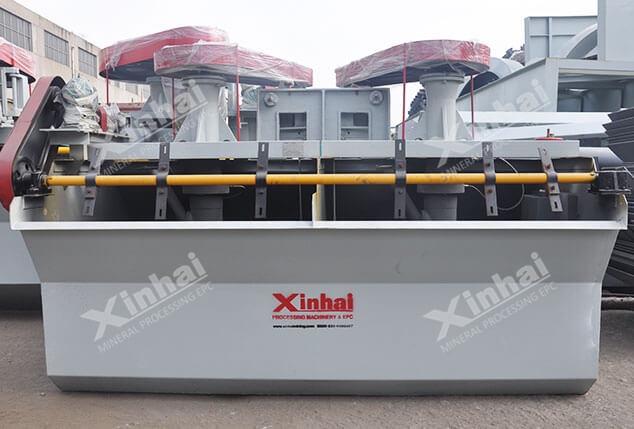
Graphite exhibits excellent natural floatability and hydrophobicity, leading most processing plants to employ flotation for mineral separation and purification. This involves adding a series of flotation reagents to enrich the graphite mineral at the gas-liquid interface, thereby separating it from impurity minerals. Common collectors include coal tar, frothers typically employ pine oil or butyl ether oil, while suppressants predominantly utilise water glass and sodium fluorosilicate.
Notably, the flotation process for flake graphite ore often employs multi-stage grinding, multiple separation stages, and regrinding and re-selection of coarse concentrates to preserve the graphite flake structure. Graphite ore flotation can achieve a purity of 80-90%, or even approximately 95%. However, when extremely fine silicate minerals and compounds of elements such as potassium, calcium, sodium, magnesium, and aluminium are present within the graphite ore, grinding alone cannot achieve complete liberation. Additional beneficiation processes are required following flotation to further refine the product.
Selective flocculation of graphite ore involves introducing polymeric flocculants into suspensions containing two or more components. These flocculants selectively adsorb specific constituents within the suspension, forming flocculated precipitates through bridging effects to achieve component separation. In industrial practice, commonly employed flocculants include sodium silicate, sodium hexametaphosphate, lignin starch, and carboxymethyl cellulose, with sodium silicate being the primary dispersant. While graphite ore selective flocculation offers simplicity and low cost, its fixed carbon recovery rate remains relatively low, typically around 40%.
The foregoing outlines common methods for graphite ore flotation and purification. It is advisable to determine recovery rates, reagent regimes, pulp pH levels, and other essential separation parameters through testing before selecting a graphite ore beneficiation method, thereby avoiding unnecessary economic losses.
The single-stage beneficiation process for limonite primarily encompasses gravity separation, magnetic separation, and flotation (both positive and reverse flotation).
Flotation serves as a common method for processing sulphide ores containing gold. It concentrates gold within concentrates of copper, lead, sulphur, and other metals, enabling comprehensive utilisation of multiple metals while enhancing gold recovery rates. This approach proves economically viable for gold ores containing diverse non-ferrous metals.
© 2021 Yantai KZ Mining Processing Technology & Equipment Inc.