24-hour service hotline
0086 18733132385
Send us an email
xrguo@xinhaimining.net

Kaolin, a high-value non-metallic mineral known for its whiteness, plasticity and heat resistance, is widely used in ceramics, papermaking, coatings and other fields. Its application value largely depends on the purification effect of the washing process, which constitutes a complete industrial chain covering mining, preliminary processing, washing purification, deep processing and product distribution.
The whole chain starts with raw ore mining. Kaolin ore is usually mined by open-pit mining, which is environmentally friendly and low-cost. After mining, the raw ore is first transported to the crushing and screening workshop for preliminary processing: large ore blocks are crushed into small particles by crushers, and then screened through vibrating screens to remove large impurities such as stones and gravel, obtaining crude kaolin particles with uniform particle size, which lays the foundation for subsequent washing.
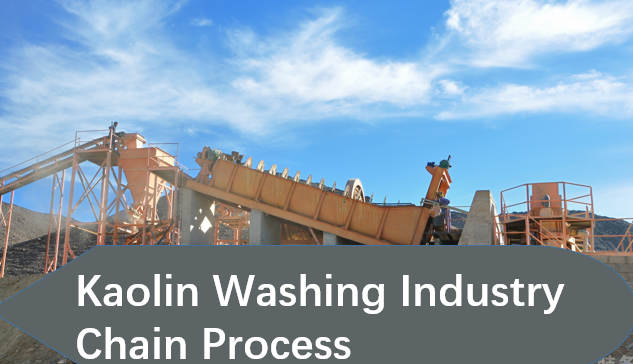
The core link of the industrial chain is the washing and purification process. The crude kaolin is sent to the mixing tank and mixed with water to form a slurry, which is then transported to the hydrocyclone by a pump for classification. The hydrocyclone separates the slurry into coarse sand and fine mud according to the specific gravity difference: the coarse sand with large specific gravity is discharged from the bottom and used as building materials; the fine mud containing kaolin is discharged from the top and enters the next link.
Subsequently, the fine mud slurry undergoes desliming, bleaching and filtration. Desliming removes fine impurities and iron-containing minerals through sedimentation or centrifugation; bleaching uses chemical agents or physical methods to eliminate iron, titanium and other coloring substances, improving the whiteness of kaolin; finally, the slurry is filtered by a filter press to remove water, forming filter cakes with moisture content of 20%-30%.
After washing, the filter cakes enter the deep processing link, including drying, grinding and grading, to produce kaolin products of different fineness and specifications. The dried filter cakes are ground by a grinder, and then classified by a classifier to meet the needs of different industries. Finally, the finished products are packaged, stored and transported to downstream enterprises, completing the whole industrial chain.
Each link of the kaolin washing industrial chain is closely connected, and the improvement of technology in any link can promote the upgrading of the whole industry, realizing the transformation from raw ore resources to high-value industrial products.
Risks encountered in deep mining—including dynamic hazards, rock pressure control, high temperatures and pressures, and gas threats—not only impact mining efficiency but directly threaten personnel safety, property security, and ecological stability. Therefore, constructing a comprehensive safety assurance system encompassing “technology selection - process monitoring - risk prevention and control” has become the core task for deep gold mining.
Nickel typically occurs in association with copper and cobalt, existing as sulfide minerals. Employing flotation to preferentially concentrate copper-nickel mixed concentrates for subsequent processing can significantly reduce production costs.
© 2021 Yantai KZ Mining Processing Technology & Equipment Inc.