24-hour service hotline
0086 18733132385
Send us an email
xrguo@xinhaimining.net

Kaolin is an aluminum-bearing silicate mineral with fine grains, appearing as a white, soft, muddy substance, and mostly without luster. Its chemical composition is quite stable, earning it the nickname "all-purpose stone." When pure, it is white and fine-grained; when containing impurities, it can have gray, yellow, or brown hues. Its appearance varies depending on its formation, ranging from loose clods of soil to dense blocks of rock.
Based on differences in mineralization geology, occurrence characteristics, and ore composition due to different mineralization processes, it can be divided into 3 types and 6 subtypes. These are:
(1) Weathering type: further divided into weathering residual sedimentary subtype and weathering leaching subtype.
(2) Hydrothermal alteration type: further divided into hydrothermal alteration subtype and modern hot spring alteration subtype.
(3) Sedimentary type: further divided into sedimentary and sedimentary-weathering subtypes, and kaolinite claystone subtype in coal-bearing strata.
Depending on the origin and type of kaolin, kaolin ore often contains quartz, feldspar, mica, and varying amounts of metal oxides (titanium oxides, iron oxides), organic matter, and carbonaceous substances that affect the whiteness of kaolin. Therefore, kaolin must undergo beneficiation processing before it can be used in industry and agriculture. Kaolin beneficiation processing mainly includes sand removal, iron removal, sulfur removal, and calcination, allowing kaolin to be better applied in various industries.
Because the origin and type of kaolin ore vary from place to place, the associated mineral impurities also differ, thus requiring different beneficiation processing methods.
The aqueous media flotation method refers to a beneficiation and purification method that uses water as a medium to separate useful minerals from impurity minerals by utilizing the differences in floating speed and solubility of various minerals in water. Currently, this method is mainly used for the beneficiation and purification of kaolin ore containing sandy minerals such as quartz, and many kaolin production enterprises in my country use this method. This method is simple, easy to operate, and has low economic cost; however, it mainly removes coarse-grained impurities such as quartz, feldspar, mica, and rock fragments, and can also remove some iron-titanium minerals. It cannot remove impurities with similar density and solubility to kaolin, and the improvement in whiteness is not very significant. It is suitable for the beneficiation and purification of relatively high-quality kaolin ore.
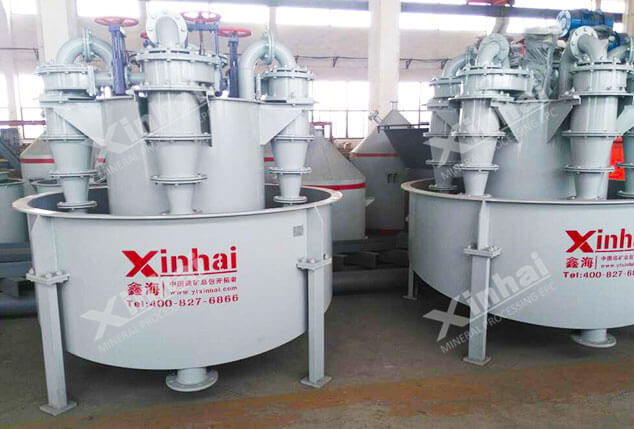
Grading separates minerals based on differences in particle size or density. Grading methods vary depending on the situation. If the particle sizes of the minerals composing the slurry differ greatly, sieve grading is generally used; if they are similar, they are separated based on density differences. Commonly used grading equipment includes vibrating screens, water winnowing machines, hydrocyclones, and centrifuges. The function of grading is basically the same as the water-based flotation method, mainly used to remove impurities such as feldspar and quartz from kaolin ore, thereby improving the purity and calcined whiteness of the kaolin.
Magnetic separation is a method that uses magnetic force to remove magnetic metallic impurities from materials. Magnetic separation utilizes the differences in magnetic properties among various ores or materials, separating them under the influence of magnetic force and other forces. It is particularly effective for removing highly magnetic minerals such as magnetite and ilmenite, or iron filings mixed in during processing. Almost all raw kaolin ore contains small amounts of iron and titanium minerals, mainly iron oxides, titanium oxides, ilmenite, siderite, pyrite, mica, and tourmaline. These coloring impurities are usually weakly magnetic, making them suitable for removal using magnetic separation.
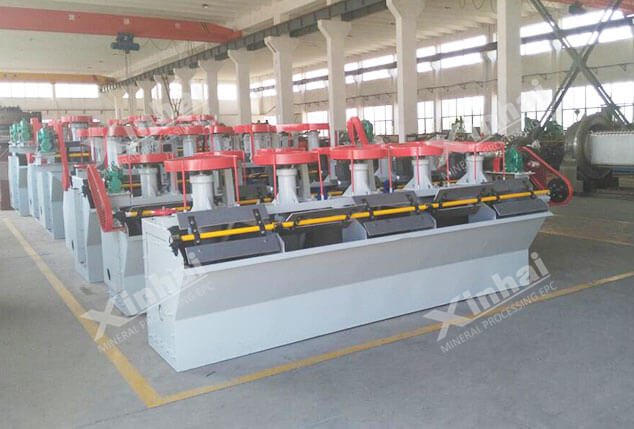
Flotation is widely used for purifying kaolin. Currently, processes and equipment are constantly being improved and updated, resulting in higher whiteness in kaolin concentrates to meet industrial needs. The purpose of kaolin flotation is to remove colored minerals and improve its whiteness. It is generally divided into carrier flotation and carrierless flotation methods (such as TREP and ECCI).
The initial beneficiation method for kaolin was carrier flotation, followed by the development of carrierless flotation processes. The collectors used in kaolin flotation are mainly fatty acids such as dodecaneamine, triethanolamine, and pyridine. Currently, hydroxamic acid is also used as a collector in kaolin flotation, with sodium lignosulfonate or calcium as modifiers.
Chemical purification utilizes the acid- or alkali-soluble properties of certain associated impurities in minerals, using acids or alkalis to dissolve and remove them. Iron and titanium minerals are the most common coloring substances in kaolin, distributed to varying degrees in each type of kaolin. Common iron and titanium minerals include pyrite, limonite, hematite, siderite, magnetite, and titanium oxide, with ferric iron being the most common. These iron and titanium minerals cause kaolin to exhibit varying degrees of gray, brown, and pink hues, reducing its whiteness. Due to the different properties of iron and titanium minerals, different purification processes can be employed. For high-iron and titanium-containing kaolin, beneficiation, purification, and whitening methods such as reduction, redox, acid leaching, and reduction-complexation can be used. Reduction-complexation is the most effective, and commonly used reagents include sodium hypochlorite, hydrogen peroxide, potassium permanganate, hydrochloric acid, sulfuric acid, and oxalic acid.
The main purpose of kaolin beneficiation, purification, and whitening methods is to increase the grade, purity, and whiteness of the kaolin. In summary, current kaolin beneficiation, purification, and whitening methods mainly include physical, chemical, and physicochemical methods. Physical methods mainly include aqueous flotation, classification, magnetic separation, and ultrafine grinding; chemical methods mainly include flotation, chemical purification, microbial bleaching, calcination, and surface modification; physicochemical methods mainly include flotation, and physical and chemical methods can also be used in combination. These beneficiation, purification, and whitening technologies are not entirely the same, each with its own advantages and disadvantages. They can be flexibly applied in the kaolin industry to enable better development of the kaolin sector.
Alluvial sand deposits are secondary enriched ore bodies formed through the natural weathering and fragmentation of primary ore deposits, followed by transport and sorting by water currents. Based on their genesis, they are primarily categorized into fluvial alluvial sand deposits and marine sand deposits.
Within the flotation mineral processing sector, traditional operational models are grappling with numerous growing pains. Historically, flotation equipment relied heavily on manual monitoring and adjustment, with operators needing to judge critical parameters such as pulp concentration and pH levels based on experience. This approach not only resulted in delayed responses but also made mineral processing outcomes susceptible to fluctuations due to human error. Simultaneously, manual operation struggles to maintain 24-hour stable production, driving up labour costs, constraining efficiency, and potentially creating safety hazards through operational errors. These pain points have created an urgent industry need for more efficient solutions, giving rise to the automated control system for flotation mineral processing equipment.
© 2021 Yantai KZ Mining Processing Technology & Equipment Inc.