24-hour service hotline
0086 18733132385
Send us an email
xrguo@xinhaimining.net

As a key strategic metal in new energy, semiconductors, and flame-retardant materials, antimony is becoming increasingly scarce. Scientific beneficiation processes are crucial for achieving efficient antimony ore recovery and improving resource utilization. Currently, gravity concentration and flotation are the two main processes for antimony ore beneficiation. These two methods are suitable for different ore types and particle size characteristics and can also be used in combination, providing flexible and efficient solutions for the separation of various antimony ores and helping mines achieve both economic and resource benefits.
Gravity concentration is a classic antimony ore beneficiation process. Its core relies on the significant density difference between antimony minerals (density 4.5–4.6 g/cm³) and gangue minerals (density 2.5–3.0 g/cm³). Through equipment such as jigs, sluices, and shaking tables, coarse-grained (>0.5 mm) antimony ore is effectively separated from gangue. This process is widely adaptable and can process most types of antimony ore, including stibnite, antimony sulfide, and antimony oxide. Only hydrous antimony calcium ore is difficult to separate due to its density being similar to gangue. It also boasts advantages such as low investment and a simple process, directly recovering qualified concentrate at the coarse-grained level. It is often used as a pre-selection operation before flotation, significantly reducing the feed volume for subsequent flotation and lowering beneficiation costs.
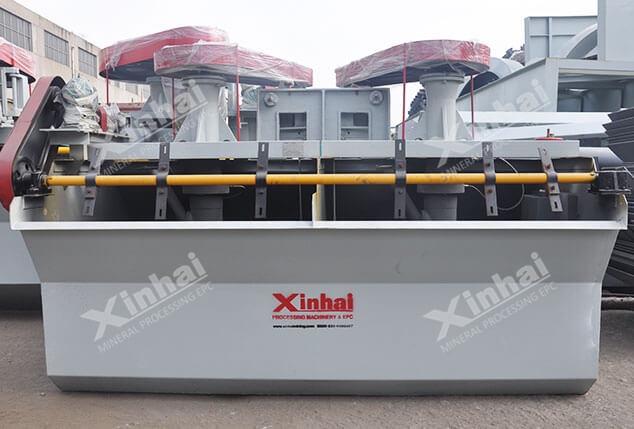
Flotation is the core method for the fine separation of antimony ore. It utilizes the hydrophobicity of antimony ore particles, or imparts hydrophobicity through reagent modification, to achieve mineral aggregation and separation at the gas-liquid interface. It is mainly suitable for antimony sulfide ores, mixed antimony sulfide-oxide ores, stibnite, and polymetallic antimony sulfide ores. Stibnite flotation requires a precisely formulated reagent system: lead or copper salts are used as activators, butyl xanthate and shale oil-ethyl thiocyanate mixtures are used as collectors, pine oil and other substances are used as frothers, and lime and sodium carbonate are used to adjust the pH of the pulp. The pulp is aerated and stirred to form mineralized froth, which is then enriched and dehydrated to obtain antimony concentrate. Flotation methods include single flotation and gravity-flotation combined processes. The former is suitable for single stibnite ores, while the latter is designed for antimony minerals with uneven particle sizes, offering higher separation accuracy.
In actual production, the selection of antimony ore beneficiation technology should be based on beneficiation tests, combined with ore type, mineral dissemination characteristics, particle size distribution, and valuable component content. When necessary, a gravity-flotation combined process should be adopted, which can achieve efficient recovery of antimony ore, comprehensive extraction of associated valuable elements, and reduced energy consumption and environmental impact, promoting the sustainable development and utilization of antimony resources.
High-gradient magnetic separators, flotation columns, high-frequency vibrating screens, and centrifugal concentrators are four core pieces of equipment. With their high efficiency, energy saving, and precise separation advantages, they have become the "hardcore equipment" for scheelite mine development, comprehensively solving the beneficiation challenges of low-grade scheelite.
The brittle and easily mud-forming nature of wolframite makes beneficiation and fine sludge treatment indispensable parts of the beneficiation process. These two stages revolve around upgrading and removing impurities, and reducing losses by removing fine sludge
© 2021 Yantai KZ Mining Processing Technology & Equipment Inc.