24-hour service hotline
0086 18733132385
Send us an email
xrguo@xinhaimining.net

Bauxite is a critical mineral resource for national industrial development and the core raw material for producing alumina; more than 90% of the world’s alumina is derived from bauxite.
Currently, bauxite desilification is primarily categorized into three methods: physical, chemical, and biological, among which the physical method is the most widely used and mature. Physical desilification achieves the separation of aluminum and silicon without altering the mineral morphology, and primarily includes technologies such as flotation, gravity separation, selective grinding, and selective flocculation.
Flotation is the mainstream process for bauxite desilification, offering advantages such as high throughput, simple operation, low cost, and minimal pollution. It relies on the differences in mineral surface properties to achieve separation using air bubbles. Flotation can be divided into direct flotation and reverse flotation. Orthoflotation is often used in conjunction with selective grinding; a typical process is selective grinding–flotation. Grinding causes aluminum minerals and silica-bearing gangue to be enriched in different particle size fractions, resulting in a concentrate with a high aluminum-to-silica ratio after classification. Reverse flotation, on the other hand, fixes gibbsite using inhibitors to remove silicate gangue, thereby efficiently improving the aluminum-to-silica ratio. Gravity separation primarily employs spiral chutes and shaking tables, often in combination with flotation, and is suitable for coarse-grain separation.
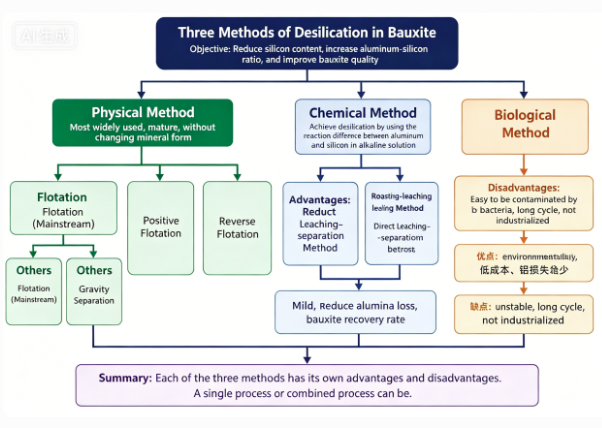
Chemical desilification utilizes the difference in reactivity between alumina and silica in alkaline solutions to achieve separation, effectively reducing alumina loss and minimizing the impact of organic reagents on Bayer process production. These primarily include the roasting–leaching method and the direct leaching–separation method. The former converts silicate minerals into amorphous silicon through roasting, followed by alkali leaching for removal, while the latter relies on differences in mineral solubility in alkaline solutions for separation.
Biological desilification centers on silicate-oxidizing bacteria, utilizing microorganisms to react with silicates to form soluble compounds that do not react with aluminum, thereby achieving aluminum-silicon separation. This method features mild conditions, no chemical reagents, environmental friendliness, low cost, and minimal aluminum loss. However, it suffers from issues such as susceptibility to microbial contamination, poor stability, and long processing cycles, and has not yet been widely adopted for large-scale industrial applications.
Overall, physical methods are currently the industrial mainstream; chemical methods are suitable for specific, difficult-to-process ores; and biological methods represent a green development direction. The synergistic use of multiple processes can achieve efficient, economical, and environmentally friendly bauxite desilification.
As an indispensable non-metallic mineral raw material in industry, barite plays a vital role in sectors such as petroleum, chemicals and rubber. Its primary use is as a weighting agent in petroleum drilling to balance the density of the drilling fluid.
Magmatic apatite has coarse crystal grains, is easily dissociated, and has good recoverability. It is often associated with magnetic minerals, so flotation is the primary method. A combined magnetic-flotation process can be employed to achieve the comprehensive recovery of phosphorus and magnetic minerals.
© 2021 Yantai KZ Mining Processing Technology & Equipment Inc.