24-hour service hotline
0086 18733132385
Send us an email
xrguo@xinhaimining.net

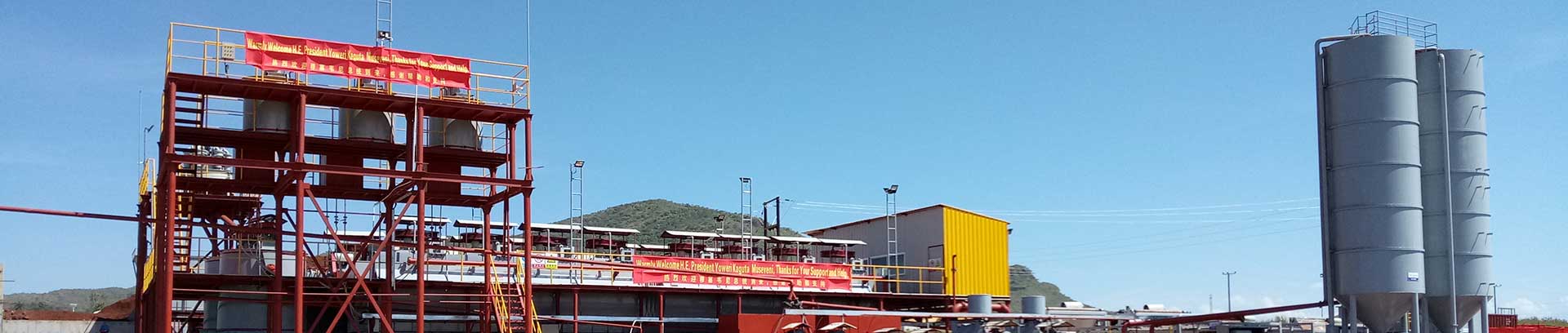
The iron ore beneficiation process primarily comprises two major systems: crushing and grinding/beneficiation. It employs a combined process of three-stage closed-circuit crushing and staged grinding and beneficiation to achieve efficient ore separation and grade enhancement.
The crushing system is centred on a three-stage closed-circuit process. The raw ore first enters the primary crushing stage, where it is reduced to a medium particle size by a jaw crusher; it then proceeds to the secondary crushing stage, where a cone crusher further reduces the size; finally, it enters the tertiary crushing stage, where a short-head cone crusher reduces the material to a finer particle size. Belt conveyors link the various crushing stages. The material from the medium and fine crushing stages is fed into a double-deck vibrating screen for screening. The qualified fine ore from the undersize is sent to the fine ore bin, whilst the oversize material is fed into a dry magnetic separator. After the low-grade waste rock is separated out, the material is returned to the fine crushing stage, forming a closed-loop circuit to ensure that the final crushing particle size meets the requirements for grinding and beneficiation.
The grinding and beneficiation system employs a combination of staged grinding and staged beneficiation. Material from the fine ore bin first undergoes pre-concentration in a wet pre-concentrator, which removes some gangue in advance to reduce the subsequent grinding load. The pre-concentrate enters a closed-circuit grinding system comprising a primary ball mill and a spiral classifier; the classifier overflow enters a primary magnetic separator to produce a coarse concentrate. The coarse concentrate enters the secondary grinding system, where fine grinding and classification are achieved through a combination of ball mills, hydrocyclones and high-frequency screens; the classification overflow enters the secondary magnetic separator for further purification. The concentrate from the secondary magnetic separator then enters the washing and magnetic separation system, where the combined action of counter-current water flow and a magnetic field removes intergrown ore and fine slime, significantly improving the concentrate grade. The final concentrate is dewatered using a disc vacuum filter to produce a low-moisture product. Tailings are allowed to settle in a thickening tank, with the underflow conveyed to the tailings pond and the overflow returned to the production system for recycling.
Through the organic combination of closed-circuit crushing, staged grinding and beneficiation, and washing for purification, this process achieves efficient recovery of iron ore resources and clean production.
Industrially, the purification of spodumene primarily employs four mainstream processes: flotation, heavy-medium separation, magnetic separation, and combined beneficiation.
Due to significant variations in lithium oxide content, mineral composition and mineralisation characteristics among different lithium ores, the extraction process must be selected on a case-by-case basis. Currently, the six mainstream industrial methods for lithium extraction are flotation, magnetic separation, gravity separation, hand sorting, thermal cracking, and combined mineral processing.
© 2021 Yantai KZ Mining Processing Technology & Equipment Inc.