24-hour service hotline
0086 18733132385
Send us an email
xrguo@xinhaimining.net

As a stable barium sulphate mineral, barite serves as a vital non-metallic raw material across petroleum, chemical, medical, and other industries. With single-type barite deposits increasingly depleted, the focus has shifted towards developing barite ores with complex associated components. Their processing requires adaptable techniques, with the following four core methods being prevalent.
Gravity separation exploits density differences between baryte and associated minerals. Through steps including washing, screening, crushing, de-silting, jigging, and shaking table separation, it produces concentrates. Primarily used for residual deposits, this method yields products with grades exceeding 80%. Equipment selection depends on ore particle size: - For embedded particles >2mm: Heavy media separation (upper limit 50mm) or wet jigging (upper limit 20mm) are standard. - For particles <2mm: Shaking tables or spiral classifiers are suitable. Pre-concentration desliming via hydrocyclones enhances separation efficiency.
Magnetic separation primarily eliminates ferromagnetic minerals (e.g., siderite) from barite, yielding a low-iron product suitable for pharmaceutical applications. For finer-grained barite ores, dry-type high-intensity magnetic separators and wet-type high-gradient magnetic separators effectively remove weakly magnetic impurities, ensuring barite purity and meeting low-impurity requirements in specialised applications.
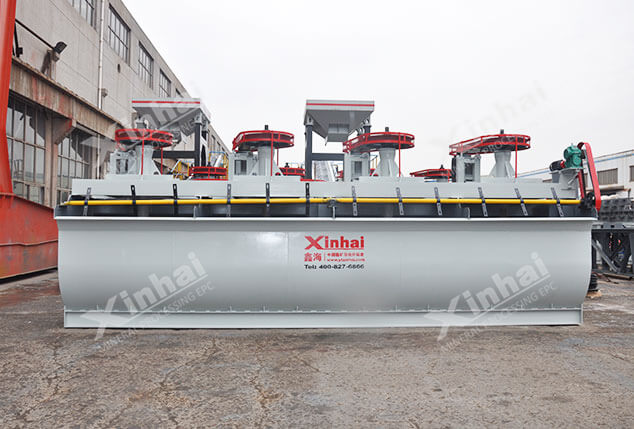
Flotation is suitable for processing barite ores with extremely fine grain sizes and gravity separation tailings. Based on collector type, it is categorised into chemical adsorption (anionic collectors, such as fatty acid alkyl sulphates or alkyl sulphates) and physical adsorption (cationic amine collectors). Due to the low efficiency and sensitivity to fines of amine collectors, anionic collectors are more desirable. In practice, sodium hydroxide is often added in ball mills to adjust the pH to 8–10, with water glass serving as a medium modifier. Flotation is conducted at 30–40% solid concentration using oleic acid-based collectors. This method is widely applied to sedimentary barite deposits and hydrothermal ores associated with sulphide minerals and fluorite.
Chemical beneficiation focuses on eliminating carbon, iron, manganese and other impurities from barite, categorised into acid leaching, oxidation, and oxidation-reduction methods. Acid leaching employs leaching agents such as sulphuric acid or hydrochloric acid to react with surface metals or metal oxides, forming soluble compounds that are separated via filtration and washing. Oxidation methods utilise oxidising agents like hydrogen peroxide or sodium hypochlorite to oxidise associated iron minerals into soluble iron salts while simultaneously converting organic matter into easily washable colourless oxides. The oxidation-reduction method first dissolves colouring substances with oxidising agents, then employs reducing agents like sodium dithionite to reduce trivalent iron ions to divalent form. Filtration and washing subsequently achieve purification and whitening.
Barytes intended for different applications exhibit varying requirements for purity, whiteness, and impurity levels. Process selection necessitates a comprehensive assessment of investment costs and product profitability. It is recommended that mine owners conduct mineral processing tests prior to finalising a scheme, tailoring the process based on trial results to achieve optimal economic returns.
Flotation serves as a common method for processing sulphide ores containing gold. It concentrates gold within concentrates of copper, lead, sulphur, and other metals, enabling comprehensive utilisation of multiple metals while enhancing gold recovery rates. This approach proves economically viable for gold ores containing diverse non-ferrous metals.
As a key non-metallic mineral, barite, with characteristics such as high specific gravity, low toxicity, and strong chemical stability, has become a core raw material in fields like oil drilling, coatings, rubber, and medicine. Barite used in drilling fluids can balance downhole pressure, while adding barite to coatings can improve coverage and weather resistance.
© 2021 Yantai KZ Mining Processing Technology & Equipment Inc.