24-hour service hotline
0086 18733132385
Send us an email
xrguo@xinhaimining.net

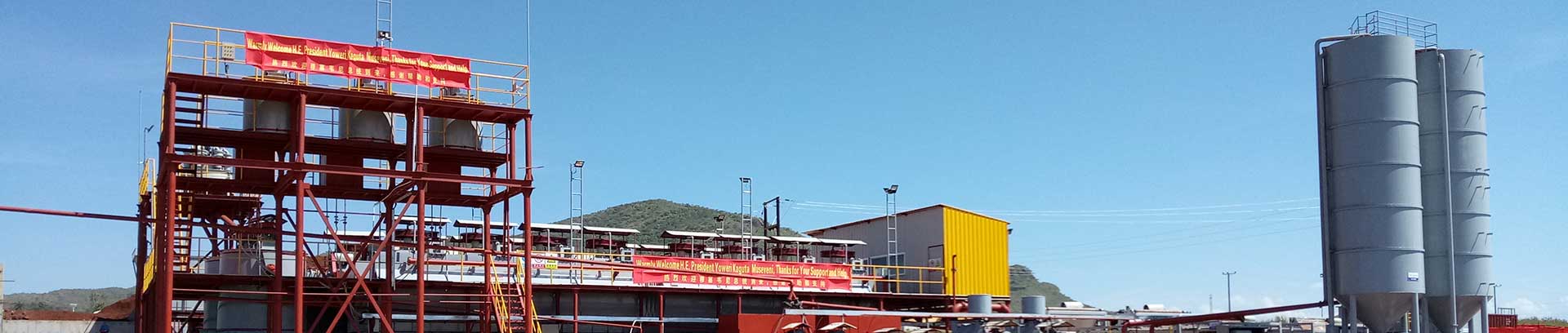
Crushing and grinding are the core processes at the front end of barite beneficiation, with the primary objective being to achieve ore liberation, release individual barite particles, and meet the particle size requirements for downstream separation. The entire process is divided into a three-stage equipment system comprising primary crushing, secondary and fine crushing, and grinding.
The mainstream equipment for the coarse crushing stage is the jaw crusher, which is suitable for processing large chunks of raw ore. The equipment has a simple structure, low operational and maintenance requirements, and relatively low overall running costs; however, its drawback is a wide range in the output particle size distribution and poor particle uniformity, so it is generally used only as the first stage of crushing. For ores of medium hardness, impact crushers may be selected; these rely on high-speed hammer impact to crush the material, offering a high crushing ratio and stable throughput, whilst producing a uniform particle size that simplifies subsequent screening processes. For barite feedstock with higher hardness, cone crushers are suitable for the medium and fine crushing stages; these machines are wear-resistant and durable, with outstanding fine crushing efficiency, enabling the stable production of fine-grained crushed material.
For the fine and ultra-fine crushing stages, high-pressure roller mills may be selected. These combine both crushing and grinding functions, offer significant energy-saving advantages and are highly adaptable to automation, thereby substantially reducing overall energy consumption during the grinding process. The grinding process is divided into two categories of equipment: coarse grinding and fine grinding. Rod mills are predominantly used for coarse grinding operations; utilising steel rods as grinding media, they produce material with a coarser particle size, suitable for the separation of coarse-grained barite. Ball mills have a broader range of applications; they rely on the impact and grinding action of steel balls and steel segments to liberate minerals, are suitable for ores of various hardnesses, and can produce slurries of different finenesses. Vertical mills integrate drying, grinding and classification functions into a single unit. With a small footprint, they are suitable for the preparation of ultra-fine powders in the deep processing of barite, delivering a stable and controllable final particle size.
The complete crushing and grinding process requires supporting screening and hydraulic classification equipment to separate material of the required particle size through classification and screening, whilst non-conforming material is returned to the crushing stage for reprocessing. The configuration of equipment must be determined comprehensively, taking into account ore hardness, target product particle size and the processing capacity of the production line. Optimising the crushing and grinding process can reduce over-grinding, lower energy consumption and equipment wear, and improve the separation efficiency of downstream gravity and flotation processes, thereby controlling the overall operational costs of mineral processing at source.
Carbon-bearing, high-sulphur and high-arsenic ores are typical examples of difficult-to-process gold ores. Fine-grained gold is encapsulated within sulphide minerals, whilst the carbonaceous components readily adsorb leached gold, leading to gold entrapment. As a result, direct leaching yields low gold recovery rates, necessitating the use of pretreatment processes to liberate the encapsulated gold.
Gold ore occurs in complex forms, and the beneficiation processes suited to free gold, associated gold and low-grade gold ores differ significantly. Currently, the industry-standard gold extraction processes are categorised into four types: gravity separation, flotation, amalgamation and heap leaching.
© 2021 Yantai KZ Mining Processing Technology & Equipment Inc.