24-hour service hotline
0086 18733132385
Send us an email
xrguo@xinhaimining.net

White tungsten ore is generally characterised by low grade, complex mineral composition and a wide range of grain sizes, resulting in a relatively difficult beneficiation process. As a single beneficiation method is unlikely to achieve the desired results, a combination of multiple processes is commonly employed in actual production. Currently, the main beneficiation methods for white tungsten ore include gravity separation, magnetic separation, chemical beneficiation and flotation, of which flotation is the most widely used and can be further divided into ambient temperature flotation and heated concentration.
Gravity separation relies on differences in the density of mineral particles to achieve separation. With a density of 5.8–6.2 g/cm³, white tungsten ore exhibits a significant density difference compared to gangue minerals such as fluorite (3.0–3.3 g/cm³) and calcite (2.6–2.8 g/cm³), allowing for effective separation via gravity separation. However, this method requires the target mineral to be sufficiently liberated to ensure the concentrate grade meets specifications.
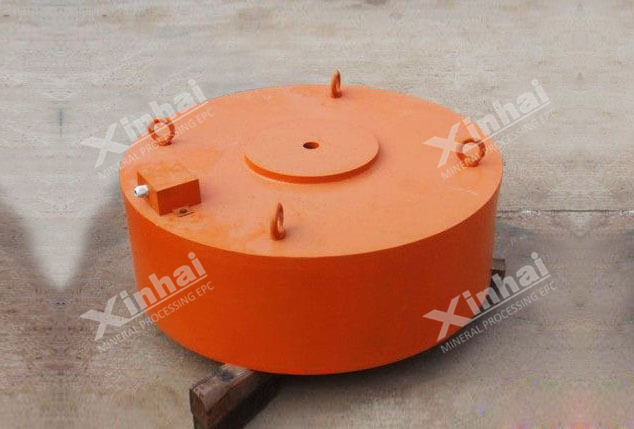
Magnetic separation relies on differences in mineral magnetism for separation. As wolframite itself is non-magnetic, its application is limited; it is primarily used to separate magnetic minerals such as wolframite and magnetite that occur in association with wolframite. Due to its inherent limitations, magnetic separation is often combined with gravity separation and flotation to enhance separation efficiency.
Flotation is currently the most effective and widely used technology for processing scheelite, being particularly suitable for the recovery of low-grade, impurity-rich scheelite resources. Ambient-temperature flotation is suitable for mines where quartz is the primary gangue mineral; it offers the advantages of low operating costs, low energy consumption and simple operation, with separation achieved through optimised reagent regimes; Heated flotation, on the other hand, involves heating the rough concentrate to 80–90°C, adding water glass and stirring, thereby reducing the floatability of calcium-bearing gangue and focusing on improving the grade of the concentrate. The two flotation processes have clearly defined roles: room-temperature roughing ensures recovery rates, whilst heated concentrating ensures grade.
Iron ore beneficiation is an essential purification step before smelting. Its main purpose is to increase the iron content, separate unwanted gangue minerals, and ensure that the raw material meets metallurgical requirements. It mainly includes crushing, grinding, magnetic separation, and dewatering, combined with screening and flotation processes to achieve efficient purification.
Commonly used industrial leaching agents for quartz sand include hydrochloric acid, sulfuric acid, oxalic acid, and hydrofluoric acid. A typical process flow is: crushing → washing → magnetic separation → acid leaching → washing → dehydration → drying. After the raw ore is crushed, it is first washed to remove some easily soluble impurities, and then magnetic separation is performed to remove most of the mechanical iron, thus creating favorable conditions for subsequent acid leaching.
© 2021 Yantai KZ Mining Processing Technology & Equipment Inc.